



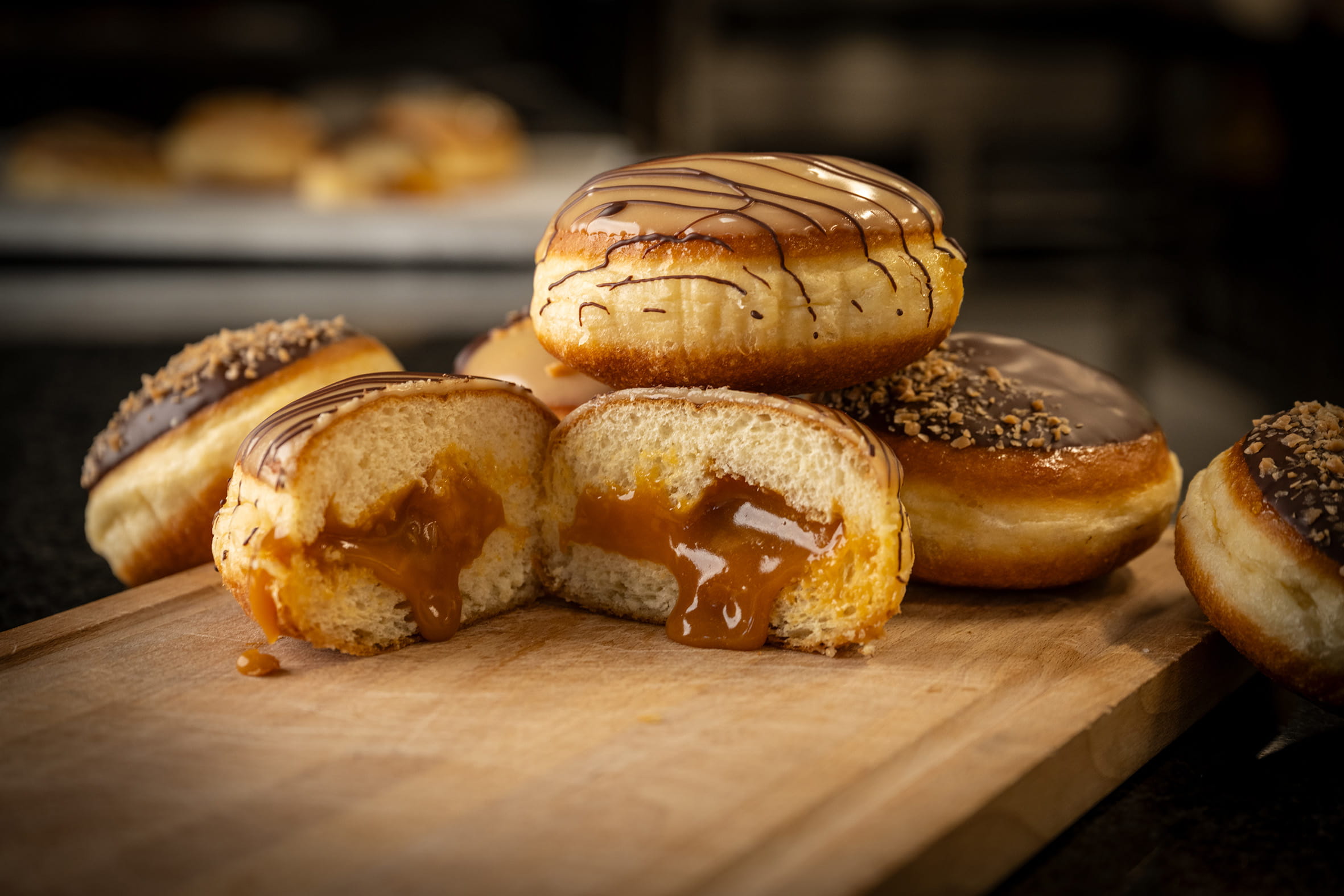
Choosing a filling for an industrial bakery, viennoiserie or pastry product is not just about taste. It is a technical trade-off between several interdependent parameters: migration, rheology, bake stability, freeze/thaw stability and flavor intensity in the finished product.
Key takeaways
- A Bakery filling should be selected based on how it behaves in your finished product, not only on how it tastes when cold.
- The five key criteria are migration, rheology, bake stability, freeze/thaw stability and flavor profile.
- A bakestable filling must be validated against your actual baking parameters: time, temperature, humidity and dough type.
- The more precise your technical brief, the more relevant the supplier proposal will be and the faster the testing phase can move forward.
Controlling migration
Migration is the transfer of water between the filling and the surrounding dough. It is directly driven by the water activity, or Aw, of both matrices. Even a moderate imbalance can lead to soggy dough, filling hardening or accelerated sensory deterioration over the product’s shelf life.
For an industrial bakery filling, this criterion is decisive: it affects texture consistency, finished-product stability and shelf-life control.
Calibrated Aw
Adjust the filling’s Aw according to the matrix to limit water transfer.
Texturizing agents
Select texturizers able to retain water and stabilize texture.
Physical barrier
Use a suitable fat matrix to limit interactions between filling and dough.
Remember: a filling whose Aw is not documented and adjusted to your application represents a quality-drift risk. This is a point to require systematically in your supplier brief.
Rheology adapted to your process
The hot viscosity of the filling determines how it behaves during application: injection, depositing or incorporation into the mix. If it is too fluid, it can migrate before baking or create visual defects. If it is too viscous, it can clog injection nozzles or result in uneven spreading in the finished product.
A filling’s rheology changes significantly with temperature. A filling tested outside the process can therefore behave very differently under real production conditions. Validation should always be carried out at the actual temperature of your line, using your application system.
Questions to ask your supplier: what is the viscosity at X°C? What is the recommended application temperature range? Has the filling been tested on an injection system similar to yours?
Bake stability: the bakestable criterion
A bakestable filling is formulated to withstand baking conditions, generally between 180°C and 220°C, without leaking, bubbling or losing its flavor expression. This is a specific formulation property: it cannot be assumed and must be explicitly validated for your application.
Bake stability relies on several mechanisms: controlled water content to limit bubbling, thermostable texturizing agents and a fat matrix that maintains filling cohesion under heat.
Point to watch: a filling that is bakestable in a croissant is not necessarily bakestable in a cookie or filled brioche. Baking conditions vary, and so does filling behavior. Require validation on your own baking profile.
Download our full technical guide
Find the 5 criteria in detail, a summary table and the technical brief checklist to prepare before engaging with a supplier.
Freeze/thaw stability
For raw or pre-baked frozen products, the filling must withstand freezing and thawing cycles without destabilization. Key risks include syneresis, meaning water release during thawing, sugar recrystallization and separation of the aqueous and fat phases.
These properties depend directly on the formulation: choice of sugars with a cryoprotective effect, freeze-resistant texturizing agents and the fat/water balance. A filling that has not been formulated for freezing cannot simply be frozen as is without risk of deterioration.
Best practice: specify from the outset whether your product is intended for freezing. This changes the target formulation and therefore the relevant reference in the range.
Flavor profile: intensity, authenticity and consistency in the finished product
Taste performance is central, but it must be evaluated warm, in the finished product, and not on the filling alone at room temperature. Baking degrades some flavor compounds, the fat matrix changes the release of flavorings, and the sugar level influences the perception of fruity or dairy notes.
A highly flavored filling may seem excessive when cold and perfectly balanced after baking. Conversely, a filling with too little flavoring may lose intensity once incorporated into the dough.

Salted butter caramel
In an intense or softer version, with a strong nostalgic dimension.

Pistachio
A premium profile, highly sought after in indulgent applications.

Hazelnut
Toasted notes, hazelnut milk and rounder signatures.

Authentic vanilla
Natural flavoring, pod notes and a reassuring perception.

Speculoos
Spiced biscuit profiles, suited to indulgent recipes.

Tangy fruits
Lemon, raspberry and strawberry with concentrated juice.
The Metarom approach
As a European player specialized in flavorings, extracts and caramels, Metarom develops Bakery fillings that combine technical control and flavor expertise. Each reference is formulated to meet real industrial requirements: documented Aw, tested rheology, identified bakestable options and freeze/thaw stability available on request.
Our R&D team can also develop custom profiles, drawing on our triple expertise in flavorings, extracts and caramels.
| Criterion | Risk if not controlled | Key question to include in the brief |
|---|---|---|
| Migration / Aw | Sogginess, dehydration, shelf-life deterioration | What is the target Aw of the finished product? |
| Rheology | Clogging, uneven spreading, pre-baking migration | Which application system and which temperature? |
| Bake stability | Leaking, bubbling, flavor loss during baking | What baking temperature and duration? |
| Freeze/thaw | Syneresis, phase separation, altered texture | Is the product frozen, fresh, raw or pre-baked? |
| Flavor profile | Loss of intensity or taste mismatch | Is warm evaluation planned? |
What to prepare before requesting a Bakery filling
Choosing a Bakery filling cannot be done from a catalog alone. It requires a technical discussion with your supplier, supported by a precise brief on your application.
- The nature of the finished product and its process: baking, freezing, target shelf life.
- The application method: injection, depositing or incorporation into the mix.
- Baking temperature and duration.
- The target flavor profile and desired intensity.
- Regulatory and labeling constraints: allergens, vegan, value-added claims.
- Prohibited ingredients, target Aw/Brix, color, target price and forecast volumes.
Download the Bakery Fillings technical guide
Complete the form below to receive the technical guide and access the 5 selection criteria, the summary table and the full list of information to prepare for your supplier brief.
FAQ - Industrial Bakery filling
What is a bakestable filling?
A bakestable filling is formulated to withstand baking without leaking, bubbling, texture loss or excessive loss of flavor intensity. This property must be validated in the actual application.
Why is Aw important in a Bakery filling?
Aw drives water transfer between the filling and the dough. Poor balance can lead to soggy dough, filling hardening or faster deterioration of the finished product.
Can the same filling be used for a croissant and a cookie?
Not necessarily. Baking profiles, water content, dough structure and application process differ. Testing under real production conditions remains essential.
How should you choose an industrial bakery filling?
The choice must take into account migration, rheology, bake stability, freeze/thaw stability and flavor intensity in the finished product. A technical brief is therefore essential.
Download the free technical guide
Find the 5 criteria explained in detail, a summary table and the complete list of information to prepare for your supplier brief.